Why a Backflow Test Notice Should Not Be Ignored
What backflow assemblies protect, how certified testing works, and which utility-specific details homeowners need to confirm.
Reviewed Oct 2, 2026
On this page
The notice is about a connection, not ordinary water quality
Backflow occurs when water moves in the opposite direction from its intended flow. A pressure change can pull or push water from irrigation, a boiler, a pool fill, or another connected system toward drinking-water piping. Cross-connection control uses separation, approved devices, inspection, and testing to reduce that risk.
If a utility sends an annual test notice, start with the account number, device location, deadline, required tester credential, and submission method. Those administrative details belong to the serving utility; they are not countywide defaults.
Identify the device and the hazard it protects
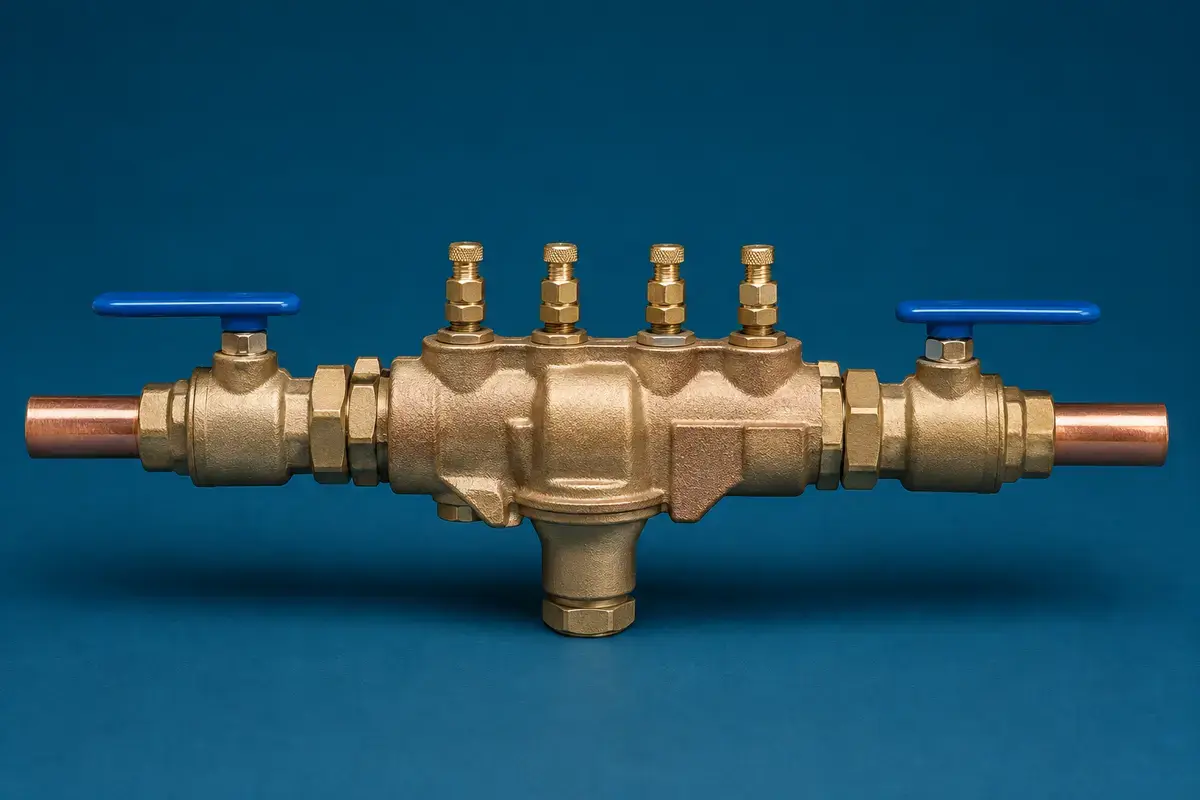
Common assemblies include pressure vacuum breakers, double-check assemblies, and reduced-pressure-zone assemblies. They are not interchangeable. Device selection depends on the connection and hazard classification established by the water supplier and applicable rules.
Ask the tester to record the manufacturer, model, size, serial number, location, and protected use. Replacement equipment may need to appear on the USC Foundation’s approved-assembly list or another list required by the utility.
Testing is a credentialed measurement
A field test uses a calibrated differential-pressure gauge connected to the assembly’s test ports. The tester follows a procedure for that device type, records whether checks and relief functions meet required values, and submits a pass or failure report.
This is not the same as looking for leaks. A device can appear dry and still fail a test. Conversely, discharge from an RPZ relief opening is a condition to evaluate, not an opening to plug.
ASSE 5110 is a widely recognized backflow-tester certification. Ask which credential the utility accepts and whether the tester will submit results directly. A general plumbing credential does not automatically establish backflow-testing qualification.
What happens after a failure
Failure does not automatically require full replacement. Debris, worn seals, damaged checks, freeze damage, or a relief component may be involved. The device may be rebuilt and retested if approved parts are available and the body is serviceable. Replacement may be more appropriate when the assembly is damaged, obsolete, unapproved, or uneconomical to repair.
Request a report showing which portion failed, what repair is proposed, and whether a post-repair test and utility submission are included.
Freeze protection without disabling protection
Outdoor assemblies are vulnerable to freezing. Protection can include correct seasonal shutdown, drainage, insulation, or an approved enclosure, depending on the system and utility rules. The wrong valve sequence can trap water, and a homeowner should not bypass or remove an assembly for winter.
Keep the device accessible. Do not cover test ports, bury an above-grade assembly, or store materials where a tester cannot operate the shutoffs.
Questions to ask before booking
- Does my utility accept your certification?
- Will you submit the report and give me a copy?
- What device and hazard category are on the account?
- Is repair available if the assembly fails?
- Is replacement equipment on the required approved list?
- Are shutoff, drainage, permit, and freeze-protection changes included?
Keep test reports and repair invoices. If a notice appears to describe a device that no longer exists, do not ignore it; ask the utility how its records can be corrected.
Philadelphia checks
Pennsylvania requires public water systems to run cross-connection control programs, including annual testing of backflow prevention assemblies. The Philadelphia Water Department (PWD) is the public water supplier for the city. Follow the account, tester, and submission instructions on the notice itself rather than another utility's process.
Plumbing permits in Philadelphia are issued by the Department of Licenses and Inspections (L&I) under the Philadelphia Plumbing Code, and permitted plumbing work is done by a Philadelphia-licensed master plumber. Pennsylvania home-improvement (HIC) registration is not a plumbing license. Ask who will pull the permit and confirm the license before work starts. This directory does not endorse a listed business.
Sources
- Cross-Connection Control Manual, U.S. Environmental Protection Agency
- Cross-Connection Control Program, 25 Pa. Code § 109.709
- Backflow Prevention Personnel Certification, ASSE International
- Backflow Preventer Types, National Fire Protection Association
- Cross-Connections and Backflow Prevention, WSSC Water
- Approved Backflow Prevention Assemblies, USC Foundation for Cross-Connection Control
- Irrigation Winterization, Texas A&M AgriLife Extension
- Cross-Connection Control and Backflow Prevention, Texas Commission on Environmental Quality
- Customer Responsibilities, Philadelphia Water Department
- PB_022 FAQ — Summary of 2018 Philadelphia Plumbing Code Amendments, Philadelphia Department of Licenses and Inspections