The curb trap: the Philadelphia plumbing part most of the country has never heard of
If you own a rowhouse in Philadelphia and you've ever watched a plumber walk straight to the front wall of the basement, point, and say "the issue is right there" — they were probably pointing at your curb trap.
Verified Sep 29, 2026 8 min read 4 sources
On this page
Almost no one outside the Mid-Atlantic knows what a curb trap is. Most modern plumbing codes don't require one. Philadelphia does. The City still builds its drainage code around the idea that every house has a J-shaped trap at the curb line, and that trap — plus the fresh-air inlet next to it — is the most important piece of plumbing many owners will never see.
This article is a plain-language explainer. It's not a how-to. It's not a sales pitch for any plumber. It's a description of what a curb trap is, where it lives in your house, who owns it, what goes wrong with it, and how to talk to a plumber about it without getting the runaround.
What a curb trap actually is
A curb trap is a running trap — a U-shaped fitting shaped like the letter "J" — installed on your house's main drain right at or near the curb line of the street. It works the same way a P-trap under a sink does: the dip in the J holds standing water, and that water blocks sewer gas from migrating from the public sewer back up into your house.
The Philadelphia Water Department itself calls it a "J-pipe that connects the drain to the lateral," and it lists the curb trap — along with the house drain, the fresh-air inlet (vent pipe), and the house storm drain — as part of the customer's wastewater plumbing, not the City's.
A few definitions, all from the PWD Sewer Connection and Repair Manual, Version 1.2 (February 2024):
- House Drain — the lowest horizontal pipe in your house that collects waste from the soil and waste stacks and carries it to the lateral.
- Curb Trap / House Trap — "A running trap installed in the House Drain to prevent circulation of gases between the Drainage System of a premises and the Public Sewer; also known as a curb trap when installed on the footway." Curb Trap and House Trap are the same thing; "curb trap" is the field term because the trap lives at the curb line.
- Lateral — the pipe that runs from the curb trap out under the footway and into the public sewer in the street.
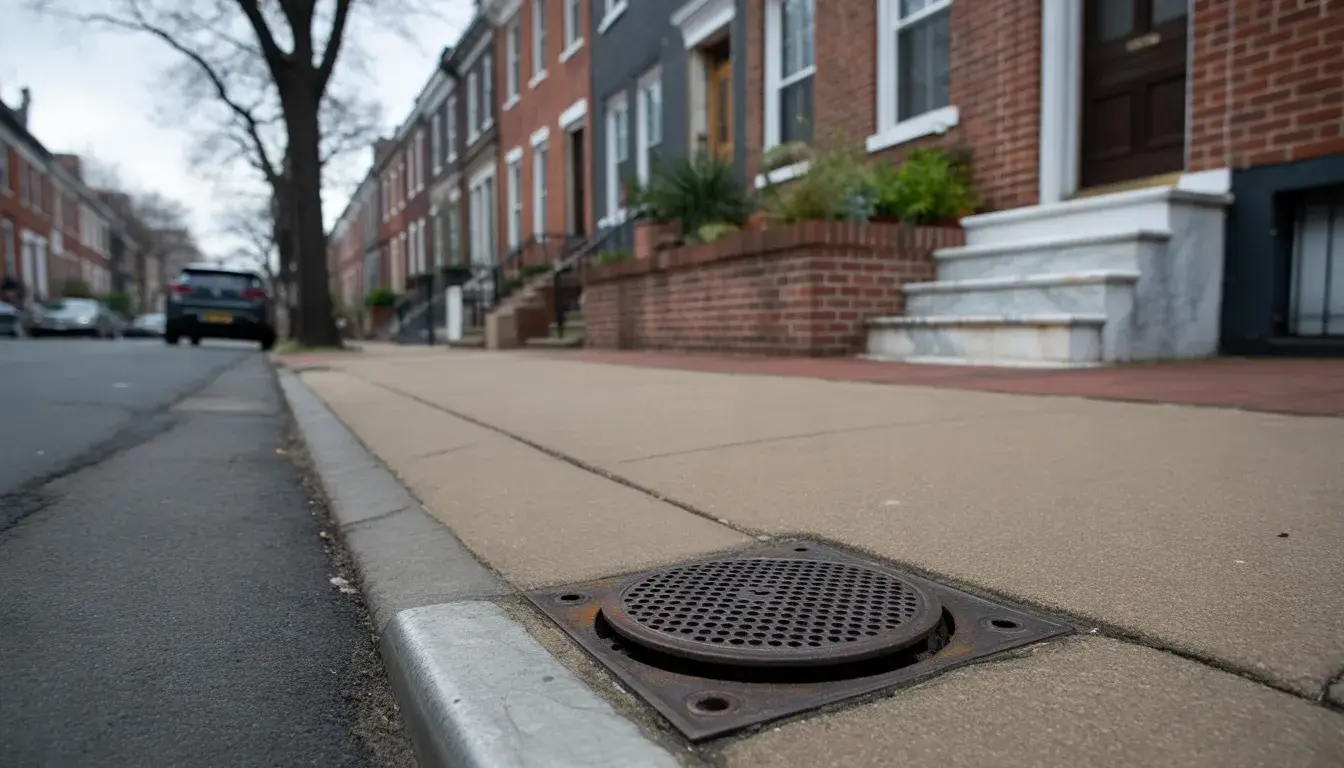
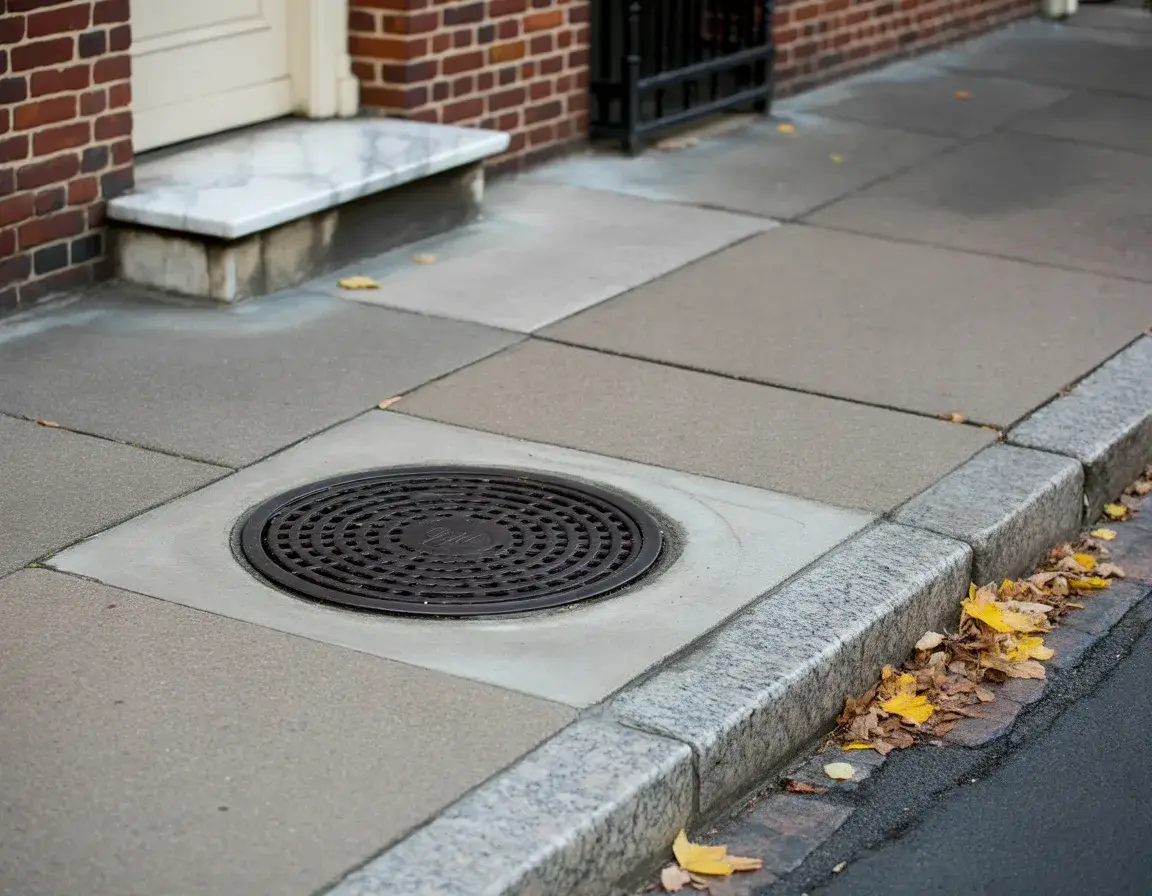
- Fresh Air Inlet (FAI) — a vent pipe that connects to the drainage system on the house side of the trap and rises to grade, usually under that round metal cover you can see in the sidewalk in front of many Philadelphia rowhouses. Its job is to let air into the drain so the trap's water seal doesn't get siphoned dry, and to keep the drain from glugging.
You almost always see the curb trap drawn at the boundary line: the public sewer is the City's; the lateral, the trap, the fresh-air inlet, and everything upstream are the homeowner's.
Why Philadelphia still has them
Philadelphia is one of the last large American cities to require a building trap at the curb line by code. The Philadelphia Plumbing Code (§P-1002.6, "Building (house) traps and fresh air inlets") says, in the current Philadelphia Plumbing Code as hosted by the City Code publisher:
A building (house) trap shall be required for every building, structure or house with a building sewer connected to sanitary or combined sewer. A building (house) trap shall be located at the curb line of the building, structure or house that it is servicing. The building (house trap) shall not be less in size than the house drain pipe it traps, and in no case less than 5 inches for sanitary or combination sewers or 6 inches for storm sewers. No flex seal coupling shall be permitted.
The same section sets the rules for the fresh-air inlet: it must lead to the outside air, open on the footway or at the curb line, have a perforated cover, and stay at least 10 feet from any door, window, or fresh-air intake for a heater or ventilation system. This isn't a historical curiosity — L&I's summary of the 2018 Plumbing Code amendments explicitly reaffirms the curb-line boundary, including the rule (§P-701.8) that an abandoned lateral must have its house trap removed and the pipe sealed with a cap or plug encased in concrete at the curb line.
In other words, when the City describes a Philadelphia drain system, it draws the line at the trap. The City owns the public sewer. The homeowner owns everything from the trap back to the upstairs bathtub.
Where in the city this applies
The short answer: citywide. The Plumbing Code rule applies to every building with a sanitary or combined sewer connection. In the trades, you'll hear plumbers say curb traps are most common in pre-war rowhouse neighborhoods — and that's true in practice — but the rule itself isn't geographically limited. A new construction home in Northeast Philadelphia is still required to have a house trap at the curb line, sized per the same section.
Philadelphia also has both combined sewers (sanitary and storm share one pipe under the street) and separate sewers (rainwater and household waste go down different public mains). The curb-trap requirement applies in both cases, though sizing differs slightly: 5-inch minimum for sanitary/combined, 6-inch for storm-only.
What actually goes wrong with a curb trap
Three things, in order of how often homeowners run into them:
- Sediment builds up in the J. Because the trap holds standing water by design, anything that floats or settles out of your household waste eventually collects in the dip. Hair, lint, grease, scale from old cast iron, bits of root — they all settle there. The trap is doing exactly what it's supposed to do, and the byproduct is a periodic need to clean it.
- The trap is the lowest point in the house drain. When the city sewer surcharges during a storm (combined sewers), or when the lateral between the trap and the sewer is blocked, the trap is where waste comes back up first. That's why homeowners describe "the clog that keeps coming back at the front wall" — the symptom of a back-up that originates between the trap and the street.
- The trap is a relic that nobody sees until something goes wrong. It lives under the sidewalk or basement floor at the front wall. Most owners never know it's there until a plumber opens the fresh-air inlet cover, or rodding brings up sediment, or a back-up shows where the trap sits.
A competent plumber can usually clear a curb trap by rodding through the fresh-air inlet, or by opening the trap's cleanout. That work is on the homeowner side of the system and is not a PWD responsibility.
Who to call, and what kind of permit is involved
For the curb trap and the fresh-air inlet, you need a Plumbing Permit from L&I (Licenses and Inspections). For the lateral between the trap and the public sewer, you need a Sewer Connection Permit from PWD. The two are split at the trap, and the PWD Manual's existing-connections table spells it out exactly that way: curb trap, vent pipe, and main house drain are L&I; lateral and slant (the fitting at the public sewer) are PWD.
This matters because:
- It tells you who to call. A licensed Master Plumber registered with the City is the only party allowed to do the work; L&I will not accept an application from anyone else.
- It tells you who inspects. PWD inspects work in the street; L&I inspects work inside the property line.
- It tells you where the responsibility line is. If the problem is on your side of the trap, that's you and your plumber. If it's in the lateral, that's still yours — the City owns the sewer main, not the lateral — but PWD permitting applies.
What to ask a plumber, and what a good answer sounds like
A few questions that show you understand the system, and the kinds of answers that should reassure you.
"Is the clog at the curb trap, in the lateral, or in the public main?" A good answer will name the location after rodding from the fresh-air inlet toward the trap and from the trap toward the sewer — and will tell you what came back on the cable (sediment, root, grease, none). A bad answer is "your line is clogged" with no specification.
"If you replace the curb trap, what size are you putting in?" Per §P-1002.6, the answer in Philadelphia is "not less than the house drain, and in no case less than 5 inches for sanitary or combined, 6 inches for storm-only." Anything smaller is not code-compliant. No flex-seal couplings.
"Who pulls the permit — L&I or PWD?" For the trap itself, it's an L&I Plumbing Permit. For the lateral, it's a PWD Sewer Connection Permit. The plumber should be able to tell you which one is being pulled before work starts.
"Will the fresh-air inlet be re-set to grade and rodded or replaced with a proper cover?" A good answer is yes — that's part of restoring the system, not an extra. A bad answer is "we'll just leave it" or "we'll cap it off." Capping off the FAI breaks the venting of the trap and lets the trap's water seal get siphoned dry, which is exactly what the vent was put there to prevent.
"Is this work going to require a street opening?" If the answer is yes, the plumber is telling you the problem is past the curb trap, in the lateral, and PWD permitting and inspection apply.
What this article is not
This isn't a price guide. Costs for rodding, replacing a curb trap, or opening a street vary widely by access, depth, sidewalk vs. cartway, and what they find when they dig. Get more than one written estimate from a Philadelphia-licensed Master Plumber; L&I's permit lookup is the easiest way to confirm a license is current.
This also isn't a recommendation for any specific contractor, neighborhood, or plumber. The curb trap system is the same from Bridesburg to Cobbs Creek; what changes is who's licensed to work on it. Verify the license, get the permit pulled in the plumber's name, and ask for the inspection sign-off before any backfill.
Sources
- Customer Responsibilities, Philadelphia Water Department — accessed Sep 29, 2026
- Sewer Connection and Repair Manual, Philadelphia Water Department — accessed Sep 29, 2026
- Trap Requirements, Philadelphia Plumbing Code (Subcode "P" of Title 4 of the Philadelphia Code) — accessed Sep 29, 2026
- PB_022 FAQ — Summary of 2018 Philadelphia Plumbing Code Amendments, Philadelphia Department of Licenses and Inspections — accessed Sep 29, 2026