What 147 main breaks taught Philadelphia homeowners: a pre-freeze guide
If you turn on the tap and nothing comes out this winter, do this first. Ask a neighbor if they have water.
Verified Oct 9, 2026 8 min read 5 sources
On this page
If they do not, the problem is on PWD's side of the curb. Call the Philadelphia Water Department at (215) 685-6300 and pick the emergency option.
If your neighbor has water and you do not, the problem is in your own pipes. Call a licensed Philadelphia plumber, not 311.
PWD cannot fix your pipes, even if they run outside the house.
That decision tree is the single most useful thing to remember before the first hard freeze. This guide explains what PWD learned from January 2026, and what to do at home before the temperature drops and stays below freezing for three days in a row.
What PWD saw in January 2026
PWD told the Inquirer on January 29, 2026 that it had responded to 147 water main breaks that month. That was a preliminary count. It came after 256 breaks in January 2025 and a record 366 in January 2018.
"In recent memory, 2018 was the worst year," PWD spokesperson Brian Rademaekers said.
Pipes are most at risk once the temperature stays below freezing for 72 hours, or three days in a row.
Philadelphia was past that benchmark when the Inquirer published its story. The city was under a single Arctic blast for at least 13 days. Overnight lows hit 2°F, with wind chill below zero.
Three Philadelphia Water Department facts from that stretch are worth holding onto:
- More than half of Philadelphia's water main breaks happen during the coldest months of a typical year.
- City mains range from 6 inches to 96 inches in diameter. Breaks in smaller pipes are most common. PWD was fixing a 6-inch main at 16th and Federal Streets in South Philadelphia on January 28, 2026.
- PWD will not fix a homeowner's frozen pipe, even if it runs outside the house. The homeowner's responsibility starts at the curb.
Why so many Philadelphia homes are at risk
The PWD spokesperson told the Inquirer that many Philadelphia homes have their main water meter by the wall facing the street. Those meters are often in uninsulated basements, some with cracked windows.
Rademaekers described the temperature problem in plain terms.
"When it drops to 6 degrees overnight, even with the heat on, that particular space right there might get cold enough to freeze the pipe up," he said.
"Once the freezing starts, the pressure will build."
This is the part that matters most for rowhouse Philadelphia, where the meter and the pipes around it typically sit in the basement by the front wall. That space can get cold enough to freeze, even when the rest of the house stays warm. It is the part of the basement the family does not use day to day.
Two practical takeaways from the same PWD guidance:
- The first sign of freezing is reduced water flow from a faucet. Check the flow before you go to bed and again when you wake up on a hard-freeze night.
- Keep the water meter area above 40°F. That is PWD's published threshold, not a guess.
What PWD says to do if a pipe freezes
PWD's published guidance on its frozen-pipes page is short. Use it as the checklist.
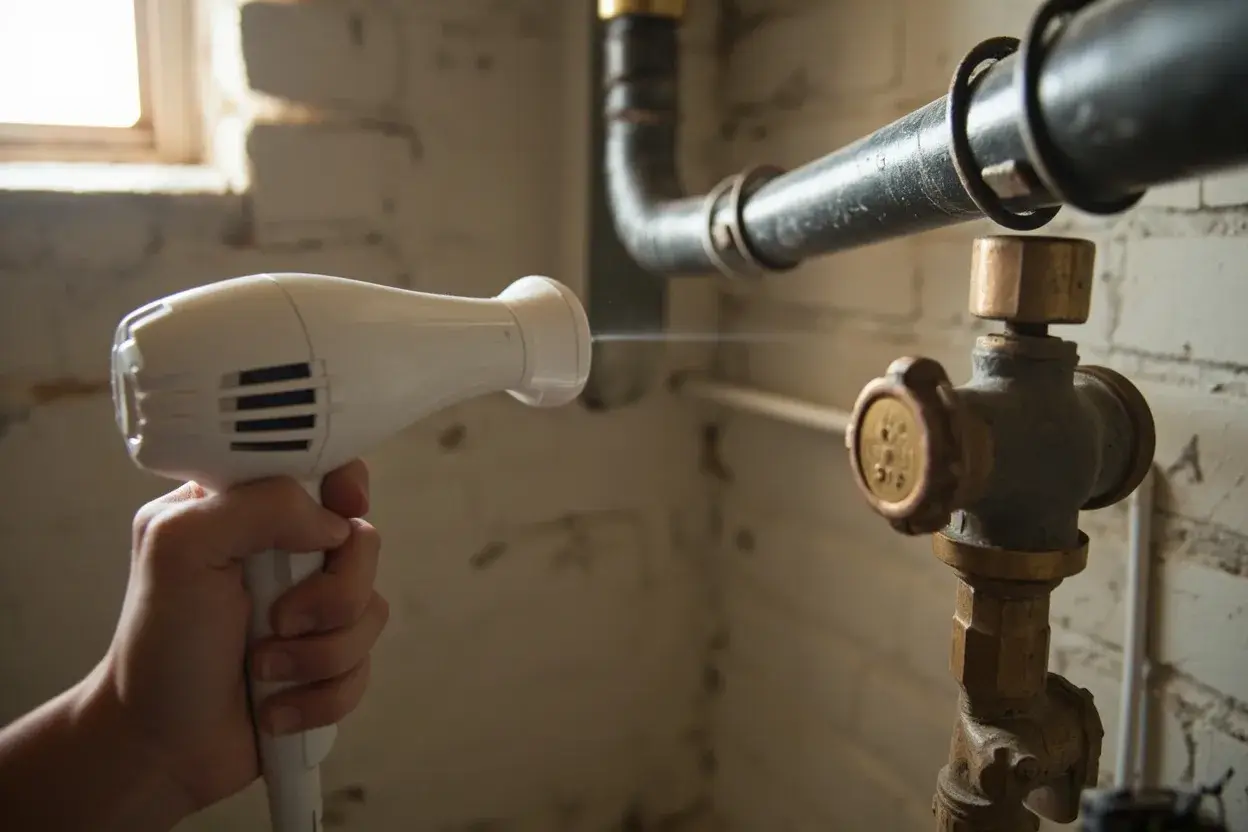
- Make sure the faucet is turned on so melting water can drip out.
- Heat the area around the pipes with a hair dryer or a space heater. Do not apply direct heat to the pipe. PWD's own graphic shows a hair dryer running near a pipe with a green check. The same graphic shows a hair dryer blowing directly at a pipe with a red no symbol.
- After the pipe thaws, look for damage. Check the pipe and the meter. If the meter is leaking, call (215) 685-6300.
- If a pipe is damaged, shut off the water at the house-side valve near the meter. A licensed plumber must make the repairs.
A short list of things PWD does not want you to do, even if a neighbor swears by them:
- Do not apply direct heat to a pipe.
- Do not use a torch.
- If you use a portable kerosene heater, the Philadelphia Fire Code allows it only in one- and two-family dwellings. Use portable propane heaters outdoors only. Pick a heater with a mark from an independent testing laboratory.
- Do not call 311 for a frozen pipe. Call (215) 685-6300.
Where the January 2026 breaks hit
Two of the sources in this article, the Inquirer and the South Philly Review, name specific blocks. The article is for an autumn audience, so it does not project these as a forecast. They are documented, dated, named events.
Watch: Woman 'in shock' after finding car encased in ice
On-the-ground footage from January 31, 2026 of a 2016 Honda Civic on the 1000 block of North Front Street in Philadelphia's Fishtown neighborhood, parked near a water main break, completely encased in ice. Direct visual evidence of the same deep freeze the article covers, showing what a winter main break looks like at street level.
Video: Woman 'in shock' after finding car encased in ice — 6abc Philadelphia.
Context and limits: Local TV news, not a primary agency source. The Fishtown block is named by 6abc, not by PWD's own published main-break list, so the article does not name Fishtown in the body and does not generalize from this single block to a citywide pattern.
- Manayunk. JD McGillicuddy's restaurant had water rushing into the basement from a broken main. Employees worked the pumps. The business stayed closed during cleanup.
- North Philadelphia. A break on the 1500 block of Oakdale Street put several feet of water in basements. Storage containers and household items floated through lower levels. Charles Leonard came home to find two feet of water in his basement and no heat. His gas water heater was submerged. Philadelphia Gas Works later confirmed four properties had to have gas service shut off entirely for safety because the appliances were too damaged to light.
- South Philadelphia. The Inquirer photographed a 6-inch main break at 16th and Federal Streets on January 28, 2026. PWD was on site that day.
The lesson from these specific blocks is not that breaks were confined to one neighborhood. The lesson is that when a main breaks in a block of rowhouses, the water finds the lowest basement first. A damaged heating system typically follows within hours.
What to do before the next hard freeze
PWD's cold-weather-tips page is the source for the prevention list. The article uses PWD's own language, in PWD's own order, where the wording matters.
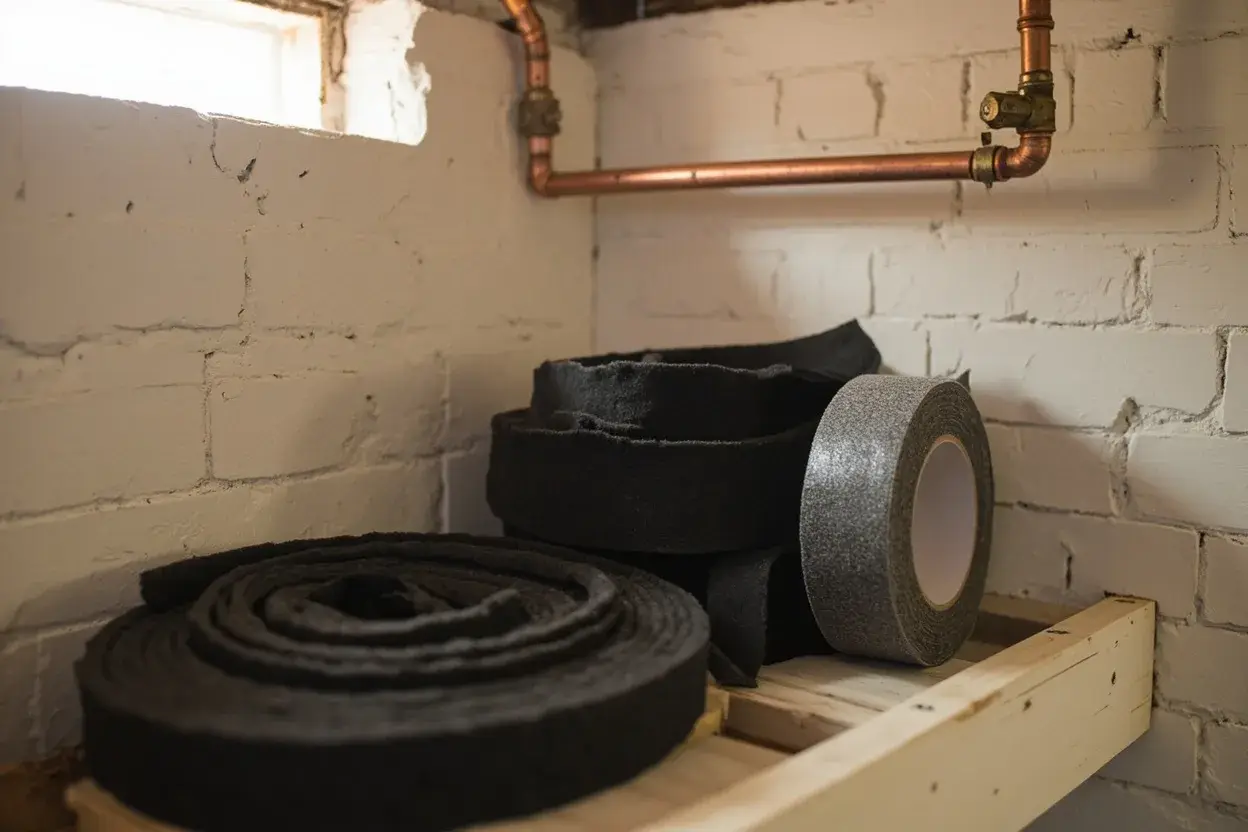
- Wrap and insulate all water pipes in unheated areas, like your basement. Pay attention to pipes near exterior walls, especially in kitchens and bathrooms.
- Let the faucet run at a trickle overnight during extremely cold weather. It costs only pennies, and moving water helps prevent freezing.
- Identify the location of the shutoff valves for your water supply, usually near the water meter. In an emergency, use the house-side service valve.
- Keep the water meter area above 40°F.
- Repair or replace broken exterior windows. Cover windows with plastic and caulk windows near water meters and pipes. Cold air blowing on a pipe increases the risk of freezing.
- Disconnect garden hoses and shut off the outdoor water supply. Most outdoor faucets have a dedicated shutoff valve inside. Use that valve, and leave the outside faucet open to drain the remaining section of pipe.
- If you plan to be away or own a vacant property during cold weather, drain and winterize your home plumbing system.
The Office of Emergency Management, in the same January 30 city release, recommends a three-day water supply at home. One gallon per person per day, including pets. Use stored containers or retail bottles. That is a separate, broader emergency-preparedness point. It belongs in the same conversation as a hard-freeze pre-check.
What to ask a plumber, and what a good answer sounds like
For a main break, call PWD. For your own pipes, you need a licensed Philadelphia plumber. PWD's frozen-pipes page points homeowners to phila.gov/li, the Philadelphia Department of Licenses and Inspections contractor lookup. Here is what to ask once you have a name.
Ask: "Are you licensed and registered with Philadelphia L&I, and what is your license number?"
A good answer is the L&I license number and a registration card you can photograph. A bad answer is "I don't need one" or "the homeowner pulls the permit." If you hear either, find another plumber.
Ask: "What is the right way to thaw a frozen pipe?"
A good answer matches PWD's published guidance. Open the faucet. Heat the area around the pipe with a hair dryer or space heater. Do not apply direct heat. A bad answer is "I use a torch."
Ask: "Will you pull the L&I permit, and will PWD inspect the work?"
Most plumbing work that touches the water service line or the sewer lateral needs an L&I permit. A good plumber pulls the permit, schedules the inspection, and is on site for the inspector. A bad answer is "you call the city yourself."
Ask: "If the meter is leaking, will you coordinate with PWD, or do I call?"
PWD's guidance is that the homeowner calls (215) 685-6300 if the meter is leaking. A good plumber helps you make that call. A good plumber stays until PWD arrives. A bad plumber says "that's the city's problem" and leaves.
Ask: "If the pipe is cracked but not yet burst, will you replace the cracked section, or replace to the next fitting?"
A good answer is a written scope of work that names the line items. A good answer covers which section, what material, what access, what permit fee, and what sidewalk restoration. A bad answer is a round number and "we'll figure it out."
Ask: "If the work takes a few days, what do I do about water service in the meantime?"
A good answer names a temporary solution and a timeline. A bad answer is "you'll be fine."
When to call PWD, in one line
PWD at (215) 685-6300 is the right number when:
- You have no water at the tap and your neighbor also has no water. Likely main break.
- You see water in the street or coming up from the ground.
- Your water meter is leaking.
- You have any question about whether the problem is yours or the city's.
PWD will not come out to fix a frozen pipe on your side of the curb. That is a licensed plumber's job, and the L&I lookup is at phila.gov/li.
Sources
- More than 100 burst water mains, freezing rivers puts Philadelphia Water Department on alert, Frank Kummer
- City of Philadelphia urges residents to be prepared for prolonged below-freezing temperatures, "City of Philadelphia urges residents to be prepared for prolonged below-freezing temperatures
- There's no water at my tap. Now what?, "There's no water at my tap. Now what?"
- Cold weather solutions, "Cold weather solutions
- Bitter Cold Triggers Multiple Philly Water Main Breaks, Flooding Homes, Gia Moretti