What It Takes to Become a Licensed Master Plumber in Philadelphia — and Why That Protects You
You cannot pull your own plumbing permit in Philadelphia. The City will only issue one if a licensed Master Plumber is on the job. The Master signs it and stays through the inspections. That is why the Master Plumber license is the gate every legal plumbing job has to pass through. The requirements behind that license are worth knowing. The person who shows up at your rowhouse has cleared several filters most people never see.
Verified Oct 6, 2026 7 min read 9 sources

On this page
This guide walks through what those filters are. It also walks through where to verify them and what to ask a plumber before you sign anything.
The Three-Step License Ladder
Philadelphia does not hand out the Master Plumber license to anyone with a tool belt. It runs a three-step ladder through the Department of Licenses and Inspections, called L&I. Each step has its own license, fee, and renewal.
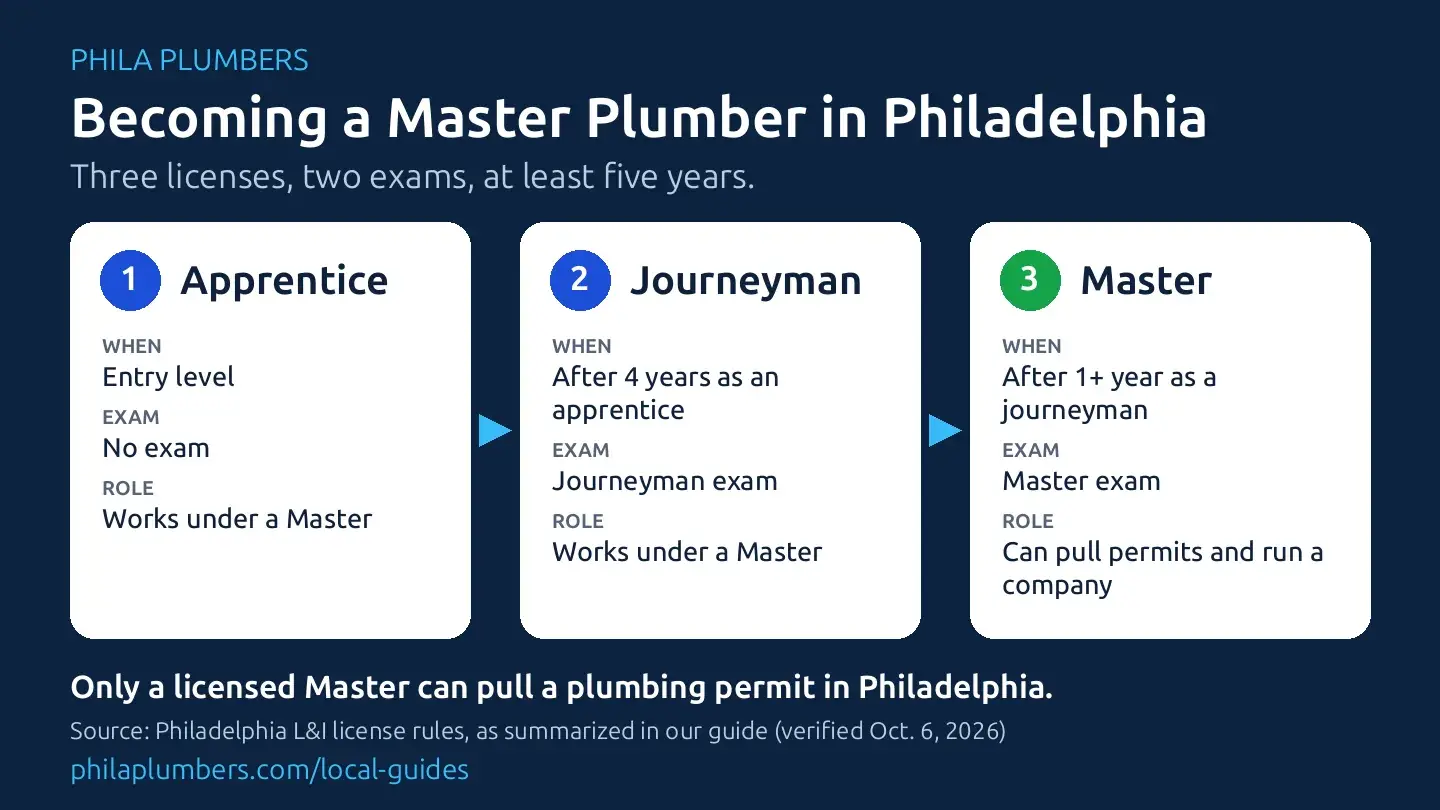
| Step | Minimum time before this step | Exam | License fee | Annual renewal |
|---|---|---|---|---|
| Apprentice Plumber | None (entry) | None | $25 | $25 |
| Journeyman Plumber | 4 years as a Philadelphia apprentice | Journeyman Plumber Exam (International Code Council) | $126 | $126 |
| Master Plumber | At least 1 year as a Philadelphia Journeyman | Master Plumber Exam (International Code Council) | $303 ($50 application fee + balance on approval) | $253 |
The journeyman license lets you do plumbing work under a Master. It does not let you operate a business. The apprentice license is the same. Work only under a Master. Only the Master license lets a plumber pull permits and run a plumbing company in the city.
L&I will accept out-of-state experience only if L&I itself approves it as equal or stronger. The default path is the Philadelphia ladder.
What the Master Plumber Has to Carry
Before the City issues a Master Plumber license, L&I checks four things beyond the training and the exam:
- General Liability insurance of $500,000 per occurrence.
- Automobile Liability insurance of $300,000.
- Workers' Compensation insurance with three specific tiers: $100,000 per accident, $100,000 per employee, and $500,000 policy limit.
- Current on all City of Philadelphia taxes.
The tax check happens again at every renewal. If a Master Plumber's taxes fall behind, the license cannot be renewed. Any open permits tied to that license are at risk. L&I also requires a Business Income and Receipts Tax ID (BIRT) and a Commercial Activity License as part of the application.
These checks are the floor. If a plumber does not have the insurance on file with L&I, they cannot legally pull your permit.
The Exam Is Real and It Is Philadelphia-Specific
Both the journeyman and master exams are written by the International Code Council, called the ICC. The ICC develops the International Plumbing Code. That is the model code Philadelphia builds on. What makes the Philadelphia exam distinct is that it must reference the current version of the Philadelphia Code and its standards.
Watch: Economic Impact of the International Plumbing Code
A short clip from the International Code Council explaining what the International Plumbing Code is and why a uniform plumbing code matters at the city level. The Philadelphia Master Plumber Examination is built on the IPC, which is the foundation this video describes.
Video: Economic Impact of the International Plumbing Code — ICCMEDIA.
Context and limits: Generic national-policy overview from ICC, not a Philadelphia-specific video. It does not show the Philadelphia exam itself. Useful for explaining the IPC, not Philadelphia-specific steps. The final article does not lean on this clip for any factual claim that requires a Philadelphia source.
The Philadelphia Code's plumbing rules sit in Title 9, Chapter 10 (Plumbing). The Master Plumber service page cites Title 9-1003 and Title 9-1004 directly. The Philadelphia Plumbing Code is the 2021 International Plumbing Code with local Philadelphia amendments. L&I adopted the 2021 ICC family of codes with local amendments on July 1, 2026.
(For context, Title 9 is officially titled "Regulation of Businesses, Trades, and Professions.")
If you live in a Philadelphia rowhouse, the local amendments are not abstract. They cover how the supply line ties in. They cover what is required on a sewer connection. They cover the backflow and trap rules your Master Plumber has to follow on the job.
Two more exam rules worth knowing:
- The exam is taken through the ICC.
- The application must be filed within 12 months of passing.
Wait longer and you have to retake the exam. The 12-month window is one reason a licensed Master Plumber who has been out of the field for years may not be current. They may need to retake and reapply.
Why This Protects You as a Homeowner
The plumbing permit page is the clearest answer to "why does this matter to me?" It states that a licensed master plumber must oversee plumbing work. That plumber must have an active license. That plumber must be current on all City of Philadelphia taxes. That plumber must have current insurance on file with L&I.
That sentence is doing a lot of work. It means:
- The person signing your permit application has been screened by L&I. They are screened for tax compliance, insurance, training, and an ICC-administered exam.
- The person standing on the permit is legally responsible for the work from the first inspection to the last.
- If the work is later found deficient, the contractor permit lookup ties it to a specific permit and the master on file.
The L&I contractor permit lookup tool is searchable by contractor name and license number. It lists permits pulled under a license. Use it to confirm the permit was pulled before work started. L&I's Atlas tool lets you look up permits and violations by property address.
If a homeowner hires someone who is not a Master Plumber, the City cannot issue the permit. The same is true if the Master license is not active. Unpermitted plumbing in a property record can derail a future sale, trigger L&I fines, and create real problems with a buyer's inspector.
What "Licensed Master Plumber" Means Day to Day
When a Master Plumber takes your job in Philadelphia, three things happen because of the license:
- They pull the permit through L&I's eCLIPSE system before work starts. The plumbing permit page lists EZ-permit carve-outs. These cover minor repairs with the same material. Replacing faucets, valves, and parts is in this group. Stopping leaks or clearing stoppages is in this group. Anything outside the EZ list needs a full permit. That permit has to come from a Master. Replacing a water heater requires a permit. Working on a private sewer lateral needs a Site Work / Utility Permit through the Philadelphia Water Department. Moving supply lines for a renovation requires a full plumbing permit.
- They schedule L&I inspections at the points the permit lists. Inspections confirm rough-in, connections, and final work. A Master who does not schedule inspections is not closing the job legally.
- They stay on the job through the final inspection. The Master on the permit is the one who signs off the work for the City. A Certificate of Approval is issued when the work passes final inspection.
For a homeowner, this is the simplest way to think about the license. A Master Plumber cannot legally do the job without taking responsibility for it on your behalf. Anything that does not involve a Master is not one of those jobs.
What to Ask a Plumber
Before you sign anything, ask these questions. The good answers are short and specific.
"Are you currently a Philadelphia Master Plumber, and what is your L&I license number?" A licensed Master should give you the number without hesitation. You can verify permits under that license on L&I's contractor permit lookup.
"Are you current on City of Philadelphia taxes?" This is a literal license requirement. A good answer is "yes" and an openness to letting you confirm.
"Do you carry at least $500,000 in general liability, $300,000 in auto, and Pennsylvania Workers' Compensation with the L&I-required limits?" A competent plumber describes their certificate of insurance and confirms it is current with L&I. Anything less than the L&I minimums is not in compliance.
"Will you pull the Plumbing Permit through eCLIPSE before any work starts?" The permit must be issued by, or with the signed authorization of, the master plumber on the job. The answer should include a permit number once issued.
"What on this job requires a permit, and what falls under the EZ-permit carve-out?" A few examples from the L&I plumbing permit page:
- Replacing a faucet, valve, or part with the same material does not need a permit.
- Removing and re-installing a toilet (when no pipes or fixtures are replaced or moved) does not need a permit.
- Stopping leaks and clearing stoppages do not need a permit.
- Replacing a water heater does need a permit.
- Working on a private sewer lateral requires a separate Site Work / Utility Permit through the Philadelphia Water Department.
- Moving supply lines, drains, or vents does need a permit.
A competent plumber draws this line for your specific job.
"Who will actually be on site — you, a journeyman, or an apprentice?" Plenty of licensed Philadelphia plumbing shops send a journeyman or apprentice to do the work. The Master pulls the permit and checks the job. That is legal and normal. A good contractor is transparent about who is doing what.
"How do you schedule L&I inspections, and at which points?" The permit lists the inspection stages. The plumber should arrange them and be on site for each.
Walk away if the plumber:
- Cannot produce an L&I license number, or tells you to skip the lookup.
- Says a permit is "not necessary" for work that alters pipes, drains, or vents.
- Asks you, the homeowner, to sign the permit application yourself.
- Will not give you a certificate of insurance or pushes you not to check it with L&I.
- Cannot tell you whether they, a journeyman, or an apprentice will actually be on site.
Bottom Line
A Philadelphia Master Plumber has cleared a specific set of hurdles. Four years as a registered apprentice. A journeyman exam. At least a year as a journeyman. A master exam on the Philadelphia Code. $500,000 in general liability. $300,000 in automobile liability. Pennsylvania Workers' Compensation with the L&I tiers. Current City taxes. Annual renewal. That is what makes your permit, your inspections, and your paper trail possible.
The simple test is whether the plumber can put a current L&I license number, a current certificate of insurance, and a permit number on the table. Then check whether the contractor permit lookup and the Atlas tool confirm them.
If they can, you have the protection the City designed the license to give you.
Sources
- Get a Journeyman Plumber License, City of Philadelphia
- Get a Master Plumber's License, City of Philadelphia
- Get a Plumbing Permit, City of Philadelphia
- Get a Plumber Apprentice License, City of Philadelphia
- Certification — Exam Catalog, International Code Council
- Find a licensed contractor and contractor information, City of Philadelphia
- Applicable codes, City of Philadelphia
- Contractor Permit Lookup Tool, City of Philadelphia
- City of Philadelphia